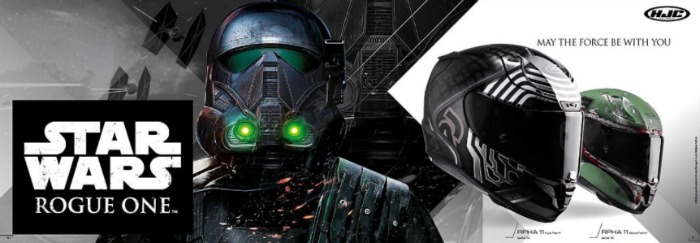
Helm Starwars

untuk para penyuka helm dan star wars

Check out Gitaskara!!

The Great Youth Choir that ever existed

Music unites every one!!!

This is default featured slide 3 title

Go to Blogger edit html and find these sentences.Now replace these sentences with your own descriptions.

This is default featured slide 4 title

Go to Blogger edit html and find these sentences.Now replace these sentences with your own descriptions.

This is default featured slide 5 title

Go to Blogger edit html and find these sentences.Now replace these sentences with your own descriptions.

Saturday, December 1, 2018

Red dead redemption

This article discusses the end of Red Dead Redemption and Red Dead Redemption 2.
Maybe it’s true that only 10 percent of the people who played Red Dead Redemption completed it, but everyone knows how it ends. John Marston, your gravel-voiced rake of a cowpoke, returns to a bucolic life on the farm after extracting revenge upon the Dutch Van Der Linde diaspora. He does chores, rounds up horses, and bonds with his son, before an army of law-men arrive and shoot the ever-living shit out of him. Marston staggers, shit shot out of him, then falls to his death. Years pass. His son, looking at his father’s grave, becomes a man, looking at his mother’s grave right alongside it. He heads out over the countryside to sniff out the location of the aging man who killed his father. By a quiet riverside he shoots the old coot dead—vengeance achieved, and a new life of violence begun in earnest.
Big-budget games don’t do stuff like this much: structurally ambitious left-turns, with passages of downtime and even outright boredom in order to more powerfully hammer home a point. Red Dead Redemption 2 was always going to live in the shadow of its acclaimed predecessor, particularly so by jumping back in time and resurrecting Marston. His scarred face peeks out of most of the game’s marketing, and arises early in the game itself, an old friend easing you into a forbidding new landscape. New protagonist Arthur Morgan’s nowhere near as appealing a character as Marston was, but the game seems keenly aware of this. He’s a meathead with a gun that other people use for their own ends. He rues his violent life, his lost love, the purposelessness of all this bloodshed. When you choose the more selfish of two options, as the game occasionally allows you to, there’s none of the delicious nastiness previous Rockstar protagonists enjoyed, just varying flavors of regret. Morgan groans wearily as he declines to help, a dark ambient fog creeping out of the speakers.


Arthur Morgan, clean-shaven
Screenshot: Rockstar

And so: Of course Arthur Morgan dies at the end. You see his death coming from a mile away, and not just because you knew the first game’s star died, but because he straight up contracts tuberculosis half-way through and is told that he will die soon. It happens on-screen. This is not thematic, but biological, and slow, like everything in this game. You’re not going down guns blazing, but lungs screaming, body tearing itself apart internally. When missions end in Rockstar games, you typically regain control of your character gazing out over some scenic vista, or rising and stretching before a new day. By the end of Red Dead Redemption 2, Morgan can be found collapsed onto rocks, wheezing wetly for minutes at a time. Your partners don’t even trust you to carry out some of the game’s final missions. During the last of the nested, regional conflicts that serve to pad out the game’s runtime, Morgan grouses to Dutch about the futility of the mission. “Why are we even doingthis?” he pleads, loading his guns and riding once more into the fray.
There’s something darkly self-aware about all of this, a video-game gunman who grows to loathe the endless cycle of violence in which he’s caught. Of course, this is nothing new in games, a medium that discovered winking postmodernity early in its development and hasn’t been able to stop coyly implicating the player in its wanton bloodshed since. BioShock’s quest-giver famously revealed the player as an automaton, blithely following orders; Spec Ops: The Line lifted liberally from Conrad, its loading-screen text gradually becoming caustic and sentient (“Do you feel like a hero yet?”). There are dozens of these examples. Red Dead’s brand of postmodernity works better than most, in part because it isn’t so self-satisfied; again, you are dying of tuberculosis for most of this game. It is a resolute downer, and when Morgan dies, face-down in the mud or gazing at the sunset, depending on how shitty of a person you played him as, you feel a sense of relief. He was in excruciating emotional pain, and you felt it—and now, at least, it’s over.
ADVERTISEMENT
Red Dead Redemption 2, like a lot of self-critical video games, wants to have it both ways; the guns are fun to shoot and Arthur increasingly hates doing it, up until he can’t anymore. Like the original Red Dead, it ends with an epilogue of Marston on his ranch, milking cows and hammering in fenceposts in a lyrical, boldly experimental sequence of video-game editing. It’s unambiguous about the fact that Marston’s happy life is the redemption Morgan died for. The beauty of the land, and the freedom Marston enjoys within it, is the sort of eternity he was denied in the first game. Tough luck for Morgan, though. His loss is absolute; he whispers goodbye to his horse shortly before dying, the tenderest moment in a game full of them. One could imagine a third game going back in time further, introducing a new, doomed protagonist, and ending with Morgan alive again in a brighter and larger open world, the cycle of redemption and retribution continuing unabated.


Red Dead Redemption 2
Screenshot: Rockstar

It sounds nice for everyone but the protagonists, who would, presumably, be trapped in increasingly larger, more beautiful places and subjected to increasingly longer, more brutal deaths. If only 10 percent of players slugged through the 18 hours of Red Dead Redemption, how many will endure the 50 hours of Red Dead Redemption 2? It’s an easier game, and it dangles a hell of a carrot to keep you moving: the promise of a vast new stretch of land to explore, overlapping much of the countryside from the first game. But it’s also slower than molasses in north Ambarino, demanding a meditative approach to play, a willingness to sink in an evening and only come away with a decent-quality pelt to show for it. The plot ranges from operatic, Witcher-esque highs, particularly the early saga of the Gray-Brathwaite feud, to lows that make you keenly feel Morgan’s disdain for his trade.
It’s too long, in other words, but it’s hard to say where to trim. The game’s just big, in every sense of the word. Red Dead Online still doesn’t have a release date, but the immediacy of online play threatens to to derail a lot of players’ momentum on the single-player experience. This would be a shame: Red Dead 2’s story, lumpy patches and all, is the most compelling Rockstar has told in an open-world game. Like pretty much all of the others, its twin obsessions are America and masculinity, but it explores them with a scale and intensity that feels uniquely contemporary. Arthur is a man whose time has come, whose era is ending, and he erodes over the course of dozens of hours, weathering as steadily as the mountains in which we meet him and atop which he dies. He’s a worse man than John Marston, but his redemption is sweeter. Afterward, you ride victorious through the sandstorms of New Austin, money falling out of your pockets, family safe at the farm. One man may be doomed and the other is dead, but in that moment, they’re the happiest we’ll ever see them.

source: Kotaku.com

Chrono trigger

Originally released for the Super NES in 1995, Chrono Trigger is a time travel story, a quest that starts out (as so many JRPGs on the Super Nintendo did) in a quaint village, but ends up spanning the entire history of the human race as the player’s party jumps between eras.


Screenshot: Square Enix (VGMuseum)

In theory, video games should provide a uniquely suitable platform for telling stories about time travel: If we’re exploring the idea of altering the future by changing the past, why not do that in a medium where the player can take control of the flow of the narrative, jumping back and forth to see the results? But very few games prior to Chrono Trigger had actually used time travel as a play mechanic—likely because such a system would be as difficult to design as it is easy to daydream about.
ADVERTISEMENT
Perhaps it was the difficulty of creating a time-travel game that attracted these seasoned creators to the idea? Chrono Trigger was the result of a collaboration between Final Fantasy creator Hironobu Sakaguchi, Dragon Questcreator Yuji Horii, and the well-known illustrator Akira Toriyama, who designed the characters for Dragon Quest but was best known for the Dragon Ball manga and anime. From interviews conducted at the time, we know that even though it took quite a while for this game to come to fruition after Horii and Sakaguchi first began discussing the collaboration, the idea of traveling back and forth between different eras was part of those discussions very early on.
Chrono Trigger doesn’t take long to get to the good stuff. A boy named Crono wakes up and heads to the town square for the once-every-thousand-years Millennial Fair. He meets a girl named Marle. A demonstration of some new technology goes wrong and the two of them end up sent back in time from 1000 A.D. to the year 600, where Marle is mistaken for her distant ancestor, the kingdom’s queen.


Screenshot: Square Enix (VGMuseum)

When Marle is rescued, the kingdom calls off their search for the missing queen, which alters time. Since the queen doesn’t get rescued, she never has kids, and thus Marle never exists, and indeed, she then vanishes in front of Crono. It’s Crono’s job to find the queen and set the timeline right. The game breaks all this logic down into a little tutorial-style vignette, leading you to believe that creating, then fixing, these time paradoxes will be a major part of Chrono Trigger’s gameplay. But it’s not. This is actually the only time the game does something like this.
In fact, for a time-travel game, Chrono Trigger starts off awfully linear in its structure. There’s little bouncing back and forth and tweaking things to see what happens, and more just progressing from era to era, figuring out more about the world’s history and the nature of the cataclysmic event that destroyed most of humanity. But that’s really what the JRPG audience wanted out of its games, after all—to use the role-playing genre to tell an intricate, if linear, story, rather than an open-ended game in which you chart your own path.
When I recently decided to pick Chrono Trigger up again, using the best version of the game (that’s the 2008 Nintendo DS edition), I wanted to take my time. No rushing to see the next plot point; I wanted to see if there were meaningful things I could do to extend my gameplay experience. So after I met Marle at the fair, I didn’t head straight into the malfunctioning machine but instead took her over to the nearby forest to fight mobs of enemies.
ADVERTISEMENT
Battles in Chrono Trigger are similar to the turn-based combat of the contemporaneous Final Fantasy and Dragon Quest games. They’re fairly simple in their scope: You can use physical attacks, a few magic spells, and a small selection of healing items. Some battles require you to be somewhat tactical with what attacks you use and on whom you use them, but they’re mostly simple in that old-school way. There are some interesting design twists: Instead of random encounters where the map screen fades out and a battle fades in, the enemies are all present on the screen as you navigate through the forest. When you get close enough to the enemies, the fight takes place then and there, in the same exact map you’re exploring—there’s no new screen meant to be a facsimile of the battlefield, as there is in Chrono Trigger’s peers. This doesn’t greatly affect how the battles play out, but it has a tremendous effect on the feel of the game overall—it makes everything more cohesive, makes the dungeons feel like living places full of activity and charm, versus sterile, empty places that warp you out to a disconnected battle scene every few paces.


Screenshot: Square Enix (VGMuseum)

Playing around in the forest while raising Crono and Marle’s levels, I re-acquainted myself with the battle system. How you can carefully skirt around enemies and not trigger battles, or how battles might have different groups of enemies depending how you approach them. Enemies might pop out of suspiciously vibrating bushes, sound alarms to call backup, or set traps to lure you into combat.


You might think that designing an entire game’s worth of situations like this, hand-animating every frame with pixel art, would be a laborious task, and you’d be right. The game’s developers later commented that creating each battle scene took nearly as much effort as creating the storyline cut scenes, not only in terms of having to animate each enemy entrance individually but having to conceive of hundreds of different surprising ways that a battle could begin.
This may be something to keep in mind when you wonder why there aren’t any other games like Chrono Trigger.


The use of a very large 32-megabit cartridge gave Chrono Trigger’s designers the space to create truly impressive scenes.
Image: Square Enix (VGMuseum)

ADVERTISEMENT
Back to the forest. Having raised Crono and Marle’s levels some, and unlocked some new battle abilities, I set out to see how much of the continent I could explore before being forced to move on. Far south of my starting point, there was a whole other town, where I could scoop up a few extra items and even upgrade my gear, trading in Marle’s starting crossbow for a better model. Chrono Trigger’s designers clearly understood the importance, in an otherwise linear RPG, of giving the player some wiggle room to move around on that line. Less of a rope, and more of a string of pearls in which you can play around a little bit at each junction before progressing to the next. When you play a linear RPG that does not let you stray at all from the path and poke around at the edges, you know it. It constricts in a way that Chrono Trigger, despite its obvious linearity, does not.
As I’d hoped, the extra time I spent battling monsters and searching for treasure paid off in the end. Once I found myself in the time period of the ruined, post-cataclysmic future, the NPCs told me to stay out of the abandoned sewers, saying I’d get destroyed by the monsters in there. But they didn’t know I’d been secretly powering up! It turns out I was able to tackle the sewers early, nabbing some excellent treasure that would make things even more fun later on.
It does make sense that Chrono Trigger needs to be linear, given the complexity of the story the designers are attempting to tell. Everything’s actually just fine in Crono’s home era, and the apocalypse—caused by a demon named Lavos that burrows up from the earth and sets everything on fire—doesn’t happen until the year 1999, a good 900 years after Crono and Marle would have presumably died of old age. We don’t find this out until we land in the ruined future, and even then it’s not even initially clear where—excuse me, when—we are.
As we jump through more time periods, the game carefully doles out bits of story (out of chronological order!) until we can fully piece together what happened with Lavos. By far the most intriguing era we travel to (and the final one that we unlock) is the kingdom of Zeal, a magical civilization that built itself above the clouds after the earth below was destroyed. It’s much more unique than the standard time-travel tropes of prehistory and the ruined future, and as one might therefore expect, it’s also critical to the main storyline.
As befits a game about time travel, you can actually go fight Lavos whenever you like, starting from very early in the game. Doing so is exactly like entering in 007-373-5963 to go straight to Mike Tyson in Mike Tyson’s Punch-Out: Sure, you can do it, but unless you’ve been grinding like hell beforehand, you’re just going to get wrecked. In both cases, it’s like a preview of a battle to come.
So the adventure continues. Along the way, we add new friends—exactly one from each era, of course—to the party. Coming off of Square’s previous game Final Fantasy VI with its 14 playable characters, Chrono Trigger cuts the cast down to a more manageable 7. You’ve got Frog, the devoted knight who just happens to be an amphibian. Or Ayla, the take-zero-shit cavewoman who leads a tribe of warriors. They’re all distinct enough, written well enough, and get enough screen time to endear themselves to players. Everybody has their share of great lines—except Crono, who atypically for Final Fantasy but quite typically for Dragon Quest is a “silent protagonist” who utters not a word. Not even when he dies.
source: Kotaku.com

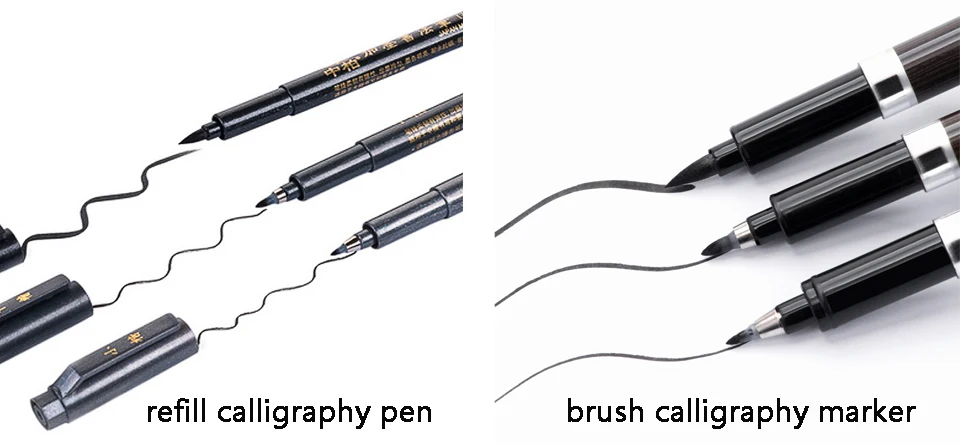
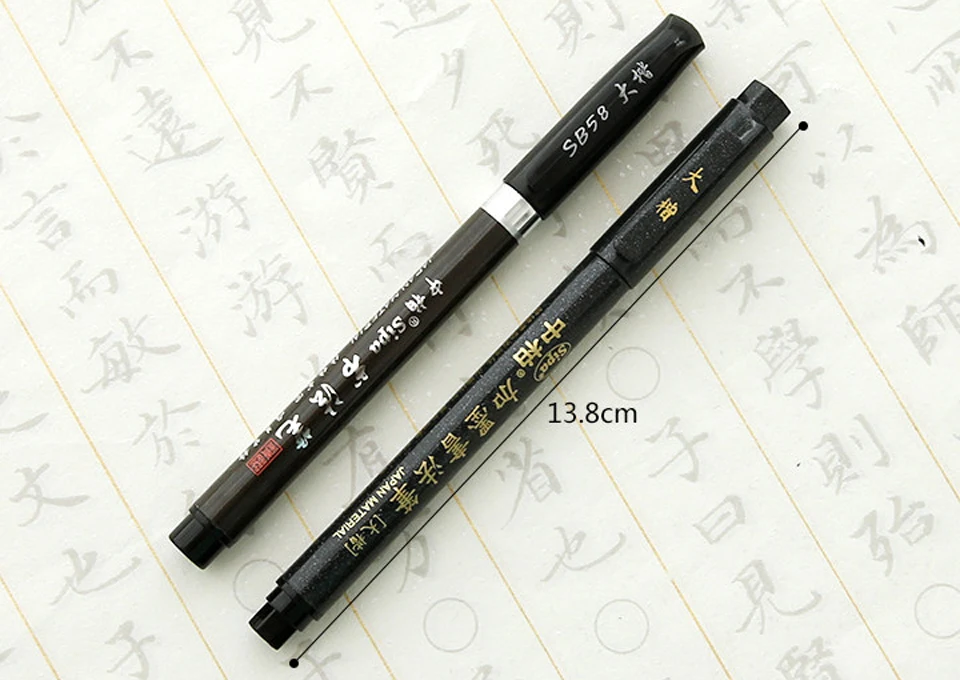
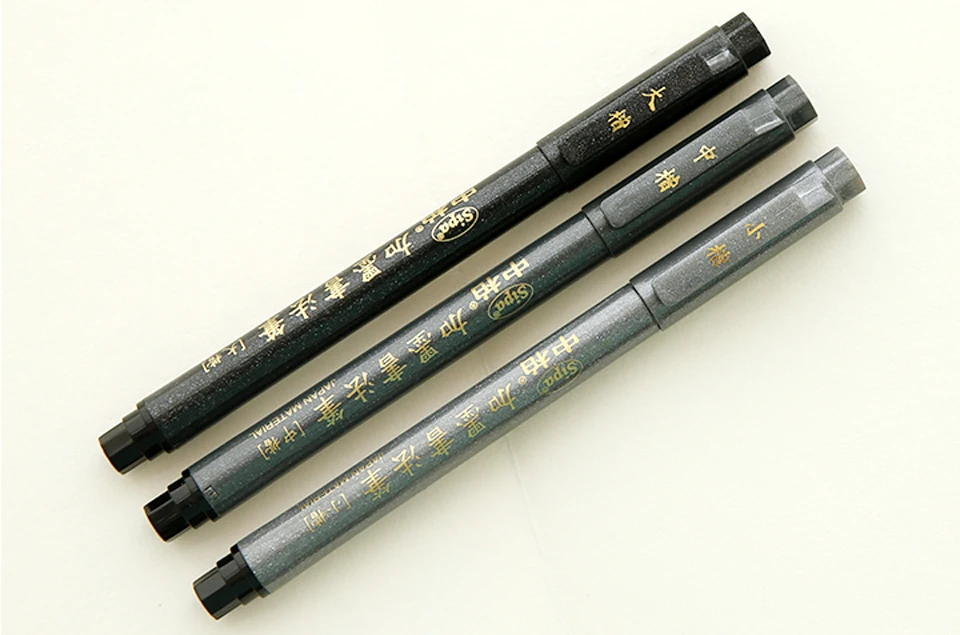
Calligraphy pen

3 stücke chinesisch japanisch kalligraphie pinsel marker oder nachfüllbar schwarz schriftzug marker weiche handschrift stift als Tombow Fudenosuke

  • enthält die weiche und harte spitze Pinsel Stifte
  • verfügt über eine flexible pinselspitze für verschiedene schriftzug und zeichnung techniken
  • schaffen extra feine, feine oder medium strokes durch eine änderung in pinsel druck
  • ideal für kalligraphie und kunst zeichnungen
  • weiche spitze und harte spitze-wasserbasis, pigmentierte schwarz tinte
  • Package Inculded: 3 stücke kalligraphie bursh stift (S, M, L) oder 3 stücke nachfüllbare kalligraphie brush marker (S, M, L)
aeProduct.getSubject()aeProduct.getSubject()aeProduct.getSubject()aeProduct.getSubject()aeProduct.getSubject()aeProduct.getSubject()aeProduct.getSubject()aeProduct.getSubject()aeProduct.getSubject()aeProduct.getSubject()aeProduct.getSubject()aeProduct.getSubject()aeProduct.getSubject()aeProduct.getSubject()aeProduct.getSubject()
katalog